2-Player Uno Rules: The Complete Guide (Including the Reverse Card Trick)
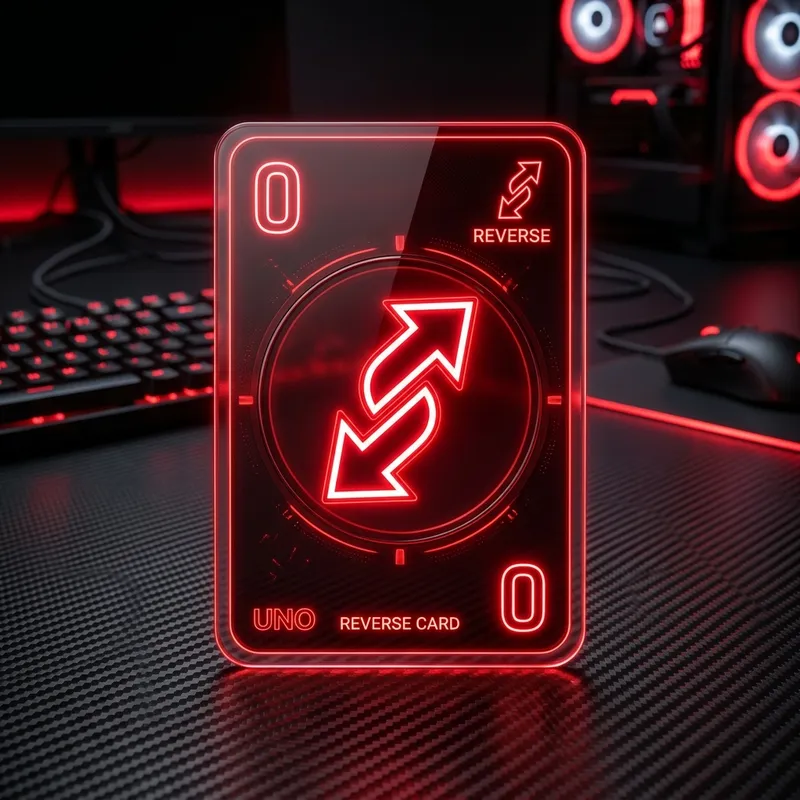
So it's just you and one other person, and you want to play Uno. Fair enough — it works great as a two-player game. But some of the cards behave differently when there are only two of you, and if you don't know about them going in, you're going to lose arguments later about whether you played that Reverse card right. Let's sort it all out.
The Big One: Does Reverse Act as Skip in 2-Player Uno?
Yes. This is official — straight from Mattel's rulebook. In a 2-player game, the Reverse card doesn't reverse a direction of play (there's no direction to reverse when it's just two people). Instead, it works exactly like a Skip card.
What that means in practice: when you play a Reverse card in a 2-player game, your opponent's turn is skipped and you play again immediately. It's actually a pretty powerful card in this format — arguably more useful than in multiplayer, where reversing the direction might not immediately benefit you depending on where you are in the turn order.
"When two players are playing, use the Reverse card like a Skip card. The player that plays the Reverse card may immediately play another card."
Complete 2-Player Rules — What Changes vs. Multiplayer
Most of the core rules are identical — 7 starting cards each, match by color or number, first to zero cards wins the round. But a few things play out differently:
| Rule / Card | Multiplayer | 2-Player |
|---|---|---|
| Starting cards | 7 per player | 7 per player (same) |
| Reverse card | Flips direction of play | Acts as Skip — you play again |
| Skip card | Next player loses a turn | Same — opponent skipped, you play again |
| Draw 2 | Next player draws 2, loses turn | Same — opponent draws 2, loses turn |
| Wild Draw 4 | Next player draws 4, loses turn | Same — opponent draws 4, loses turn |
| Calling "UNO" | Must call when down to 1 card | Same — still required |
| Challenging Wild Draw 4 | Any player can challenge | Same — you can challenge your opponent |
Strategy Tips Specific to 2-Player Uno
Two-player Uno is a different animal from the multiplayer version. There's no hiding behind other players, no hoping someone else takes the hit from a Draw 4 before it gets to you. Every bad card your opponent plays lands on you, and vice versa. Here's how to think about it:
Hoard Reverse Cards Early, Play Them Strategically Late
In 2-player, a Reverse card is a free extra turn. That's enormous. If you've got two of them and you're near the end of the game, you can chain two extra turns in a row. Don't burn them early just to match a color — hold them and deploy them when going out in two turns would end the round in your favor.
Draw 2 Is More Brutal Here
In a 5-player game, a Draw 2 card might not come back around to bother you for three or four turns. In 2-player, if your opponent plays a Draw 2 and you can't respond, you immediately draw 2, lose your turn, and your opponent plays again right after. That's potentially a 3-card swing in one move (they play a card, you draw 2, they go again). Pay attention to what colors have Draw 2s and try to hold matching colors that let you counter.
Wild Cards Are Your Most Flexible Weapons
With only one opponent, you know exactly which colors they're likely struggling with — you can watch their face (or watch how long they take to play), and you know what they've been drawing. Wild cards let you force the game into whatever color your opponent seems to have least of. Don't waste them just to change a color you don't care about. Save them for moments where switching color actually costs your opponent something.
The Mind Game of "UNO"
Calling UNO in a 2-player game is electric because your opponent knows exactly what's coming. They have one shot to hit you with something — a Skip, a Draw 2, a Wild Draw 4 — before you win. It creates real tension. Don't get cocky at one card. Make sure you actually have an answer if they come back with punishment.
Common House Rules for 2-Player Uno
Some people tweak the rules when playing one-on-one to keep it interesting. A few popular variations:
- Stacking Draw cards: If your opponent plays a Draw 2, you can play your own Draw 2 to send it back (they now draw 4). Many people play this way even though it's technically not official. See our full Stacking Rules guide for how this works.
- Reverse = Skip, but you can challenge it: Some people argue that if someone plays a Reverse in 2-player Uno, you should be allowed to challenge it like a Wild Draw 4 (i.e., demand they prove they didn't have a matching color card). This is a house rule — not official.
- First to 200 points wins (shorter game): The official 500-point target can take a while with just two people. Dropping to 200 or 300 makes sessions shorter without losing the multi-round strategy.
How Scoring Works in 2-Player Uno
Scoring is the same regardless of player count. When you go out, you earn points equal to the total value of your opponent's remaining hand:
- Number cards → face value (0–9 pts)
- Skip, Reverse, Draw 2 → 20 pts each
- Wild, Wild Draw 4 → 50 pts each
First player to reach 500 points across multiple rounds wins. See the full Uno Scoring guide for worked examples.
2-Player Uno FAQ
Does Reverse skip your turn in 2-player Uno?
Yes — in 2-player Uno, the Reverse card works exactly like a Skip. Your opponent's turn is skipped and you immediately take another turn. This is the official Mattel rule, not a house rule.
Can you stack Draw 2 in 2-player Uno?
Not by official rules. Mattel doesn't allow stacking in any format. But the 2-player consequence of a Draw 2 is already brutal (opponent draws 2 and loses their turn), so plenty of people don't bother with house rule stacking in 2-player mode. If you do want to allow it, both players just need to agree before the game starts.
How many cards do you start with in 2-player Uno?
Seven cards each — same as the standard multiplayer game. The starting hand size never changes based on player count in the official rules.
Is 2-player Uno more strategic than multiplayer?
In some ways, yes. With only one opponent, you can track their hand much more closely, and every card you play has a direct and immediate effect. There's nowhere to hide. But it also removes the social chaos that makes multiplayer Uno fun — the alliances, the timing, the "don't Draw 4 me, hit them instead" negotiations.
Can you play Wild Draw 4 on Draw 2 in 2-player Uno?
No — same rule as multiplayer. A Wild Draw 4 can only be played if you have no cards matching the current color. You can't use it to counter a Draw 2 that was played on you. You draw 2 and lose your turn, unless your house rules say otherwise.
What's the best strategy for 2-player Uno?
Save Reverse cards — they're free extra turns. Use Wild cards to force colors your opponent clearly doesn't have. Watch how quickly they play to get clues about their hand. And don't burn action cards (Skip, Draw 2) early if you're already in a comfortable position — save them for when your opponent is close to going out.
Try It Online
Practice your 2-player strategy in a real game — no physical cards needed.
Play Uno Online Free